
#098 Guitar Headphone Amp
An LM386 fixed-gain guitar headphone amp.

Notes
Yet another LM386-based audio amplifier similar to the LEAP#095 Little Gem, this time adapted as a guitar headphone amp.
There are various “headphone amp” circuits based on the LM386. After trying many of the variations, I found that going back to basics performed just about the best (per the reference circuits in the datasheet).
Features of the circuit:
- default 20x gain (no extra components required)
- simple capacitive-coupling with ~50k impedance matching for a guitar input
- ring of the 6.35mm connector is used to switch power - use with a standard mono cable
- mono output is sent to left and right channels of the headphone socket
How it performs:
- clean signal with a slight warm overdrive at maximum guitar output
- performance can be a bit temperamental on a breadboard, but when I put it on a protoboard it performs quite well.
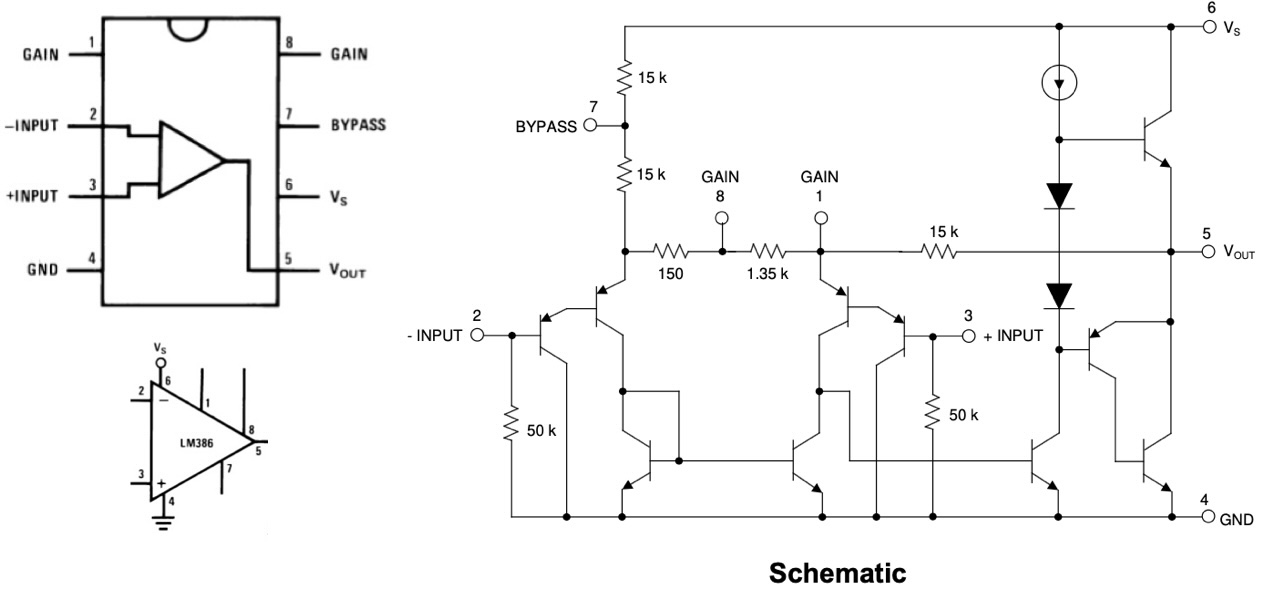
The LM386
The LM386 is a low-voltage, low-power audio power amplifier integrated circuit, originally developed by National Semiconductor in the mid-1970s. It operates from a single power supply, typically between 4V and 12V, and requires very few external components to produce an audio amplifier with a typical output power of up to 0.5W. Its internally configured voltage gain is 20 (26dB). The chip incorporates internal biasing, thermal protection and a bypass pin for reducing power-supply and bias-related noise. With its low component count, small size and ease of use, the LM386 is widely used in battery-powered audio devices, small radios, intercoms, portable speakers and simple guitar practice amplifiers.
Circuit Design
Designed with Fritzing: see GuitarHeadphoneAmp.fzz.


Testing on a breadboard:

Protoboard Build
Laid out on a protoboard:
Credits and References
- LM386 Product Info - TI
- LM386 datasheet
- Based on “Project 07 - Guitar Headphone Amplifier” from Beginning Analog Electronics through Projects
- LEAP#095 Little Gem
- MXR™ Headphone Amp - circuit details of an alternative unit